Striving Spring | Counting "Chutian Spring is Busy"

  Live up to the good spring, chutian spring ploughing is busy.

  At present, all parts of Hubei

  Seize the farming season, orderly scheduling.

  Strive to fight the "first battle" of agricultural production throughout the year

  Seize a "good start" in agricultural production

  A set of data posters

  Let’s feel together

  On the vibrant land of Jingchu

  Spring ploughing March played

  ↓ ↓ ↓

  01

  Financial support for agriculture

  Yangtze river cloud review

  Benefiting farmers promotes revitalization, helping farmers "get off to a good start", and policy "red envelopes" boost development vitality. Hubei Province has always regarded stabilizing grain production as the top priority of "agriculture, rural areas and farmers", issued funds for agricultural production development in advance, and gave full play to the role of finance in supporting agriculture, laying a solid foundation for promoting stable production and supply of important agricultural products such as grain and oilseeds.

  02

  Agricultural resources reserve

  Yangtze river cloud review

  Agricultural resources reserves are "full of food and grass", and spring ploughing is emboldened. All parts of Hubei should pay attention to the early supply of agricultural materials, strengthen the scientific and technological support of agricultural machinery, increase the intensity of agricultural technology going to the countryside, and fully guarantee the preparation of spring ploughing to ensure a good start in agricultural production this year.

  03

  well facilitated farmland

  Yangtze river cloud review

  The construction of fertile land is booming, and the granary of a big country is built. As of February 18th, the starting area of high-standard farmland in Hubei has reached more than 50% of the total task, which has turned more "looking forward to heaven" into "tons of grain fields" and changed farmers from "knowledge" to "wisdom" to continuously consolidate and improve grain production capacity and ensure that they can produce and supply when needed.

  04

  Agricultural investment attraction

  Yangtze river cloud review

  Blow the charge of attracting investment and promote the construction of agricultural industrial chain to step by step. In 2023, Hubei seized the policy dividend window period, the opportunity period of project construction and the golden period of project construction, and set off the spring offensive of agricultural investment attraction, and the land of Jingchu surged with development hopes.

  05

  crop farming

  Yangtze river cloud review

  Keep "a bag of rice" and keep "a pot of oil" steady. At present, wheat is about to start jointing, and rape is entering the bud stage, which is the key period to stabilize and weaken seedlings. It is necessary to do a good job in spring ploughing and spring management, ensure the stable supply of important agricultural products, and build a solid agricultural base.

  06

  animal husbandry

  Yangtze river cloud review

  The supply of livestock and poultry products is stable, and the "meat plate" of the people is firmly secured. On February 10th, the provincial spring field management and live pig production site meeting emphasized that it is necessary to seize the peak season of animal breeding and growth in spring, guide farms and farmers to do a good job of filling livestock and poultry in spring, expand cattle, sheep and poultry breeding, maintain a reasonable production rhythm, and ensure sufficient market supply.

  07

  fishery

  Yangtze river cloud review

  The sky is blue and the land is green, and the water is clear and the fish is fat. As a province of thousands of lakes, Hubei is "the leader" in fresh water and aquatic products. Riverside plumbing is an important period for fishery breeding. Fishery departments in Hubei Province have accelerated green development, actively promoted aquaculture enterprises to breed in spring and optimize breeding varieties, and played the "Spring Song" for high-quality fishery development.

  The spring in Jingchu is gradually flourishing, and farming is expensive in a year. Food security is "the biggest in the country", and Hubei has a good spring ploughing "first move", and agricultural production is full of momentum. Spring ploughing, agricultural materials first; Good varieties and good methods, agricultural technology to the countryside; Increase production and income, and empower technology. From Jianghan Plain to the hillock in northern Hubei, from the banks of Qingjiang River to Enshi Chashan, countless children of Jingchu worked hard, sweated, riveted and stretched their bows, and went all out to promote agricultural production in spring, making the agricultural foundation more stable and the rice bowl more secure.
Just now! Sudden in the Middle East!

Over the weekend, the situation in the Middle East heated up sharply.

According to the latest news, the United States quickly deployed warships in place to "protect" Israeli and American troops in the region, hoping to prevent Iran from launching a "direct attack" on Israel. A US Department of Defense official revealed that the United States is sending more military units to Israel to strengthen regional deterrence and strengthen the protection of US troops.

According to the latest report of CNN, the United States has observed that Iran is moving military assets, including drones and cruise missiles, which indicates that "Iran may be preparing to attack Israeli targets from its own territory". One of the people familiar with the matter said that the United States observed that Iran had prepared as many as 100 cruise missiles.

Facing the risk of further escalation of the situation in the Middle East, the global market is becoming even more tense. Among them, the international oil price fluctuated greatly, and the global benchmark Brent crude oil once exceeded $92/barrel; Wall Street’s so-called "panic indicator" VIX index rose to its highest level since last October.

The United States quickly deployed warships in place.

On April 13th, the reference news quoted the website of The Wall Street Journal as saying that the United States quickly deployed warships to "protect" Israeli and American troops in the region, hoping to prevent Iran from launching a "direct attack" on Israel.

Earlier, a person familiar with the matter warned about the time and place where Iran might launch an attack.

It is reported that the commander of the US Central Command, General Curilla, discussed the possible Iranian attack with Israeli Defense Minister galante in Israel on the 12th.

According to the Israeli Defense Ministry statement, galante said: "We are prepared to defend ourselves on the ground and in the air, and work closely with our partners. We know how to respond."

U.S. officials said that the U.S. action included the redeployment of two destroyers, one of which was already in the area and the other was redeployed to the area. American officials also said that at least one of them was equipped with the Aegis missile defense system.

According to the US Army Times website reported on April 12, US officials confirmed on April 12 that in the face of reports that Iran may launch an attack on Israel, the Ministry of National Defense is mobilizing more troops and equipment to bases in the Middle East.

A Pentagon official said that these transfers are aimed at "strengthening regional deterrence and improving the protection capability of the US military". The Pentagon did not disclose information about the number of troops or the specific assets transferred to the area.

Earlier in the day, White House national security spokesman John Kirby also refused to disclose the specific details of the changes in the US military posture in the region, but said that government officials are paying close attention to the situation.

Kirby said that the United States has taken concrete actions to "ensure" that the US troops stationed in the region "make proper preparations" in the event of an attack.

At present, the United States has deployed about 40,000 military personnel in the Middle East. Another 1,000 people are going to the area to help build a floating pier near the coast of Gaza.

According to reports, Iran’s Supreme Leader Ayatollah Ali Khamenei said that he would retaliate against Israel’s air strike in Damascus on April 1, which killed at least 13 people, including a senior Iranian officer.

In addition, the State Council is also taking urgent action to issue safety warnings to all government employees and their families of the US Embassy in Jerusalem.

The Israeli military said that if the Iranian side retaliates against the air strikes on Iranian consular offices in Syria, the Israeli army will fight back. On the afternoon of the 12th, US President Biden warned Iran "not" to take action, and emphasized the US security commitment to Israel, saying that Iran would not succeed.

In the current tense situation, Hezbollah armed forces in Lebanon took the lead. On the evening of April 12, local time, rocket warnings sounded several times in northern Israel, and the "Iron Dome" defense system intercepted several times. According to Iranian media, "at least 50 rockets" were launched from southern Lebanon to northeastern Israel.

The Israeli army statement said, "About 40 rockets were fired from Lebanon to northern Israel, some were intercepted, and the rest landed in an open area. There are no reports of casualties." The Israeli army also claimed to have shot down two unmanned aerial vehicles (UAVs) loaded with explosives launched by Hezbollah in Lebanon at Israel.

Iran warning

On April 13th, the World Wide Web quoted the American news website "Axios" as saying that three American officials told the media that Iran sent the following message to Biden’s government through several Arab countries this week: If the United States intervenes in the conflict between Israel and Iran, the US troops stationed in the region will be hit.

A US Department of Defense official said that the United States is sending more military units to Israel to strengthen regional deterrence and strengthen the protection of US troops.

According to the report, a senior American official said that the United States insisted that it did not participate in the air strike. In this regard, the message conveyed by the Iranian side is, "Whoever attacks us, we will attack him, so don’t conflict with us, and we won’t conflict with you."

An American official told Axios that from the information received through several Arab countries, it is not clear whether Iran is threatening to attack the US military if it helps Israel intercept Iranian missiles, or whether it will only attack the US military if it participates in Israel’s retaliatory actions.

According to the US official, the overall assessment of the US intelligence community is that Iran will only attack the US military if the United States and Israel jointly fight back.

"prepared 100 missiles"

On April 13th, local time, according to the latest news from CNN, people familiar with American intelligence revealed that the United States observed that Iran was moving military assets, including drones and cruise missiles, which indicated that "Iran may be preparing to attack Israeli targets from its own territory".

According to the report, it is uncertain whether Iran really launched the first round of attacks from its own territory, or whether it is deliberately posing in an attempt to prevent Israel or the United States from launching a possible counterattack against its territory.

One of the people familiar with the matter said that the United States observed that Iran had prepared as many as 100 cruise missiles.

The report also said that a person familiar with the matter said that Iran hoped that their attack on Israel would look "significant" in retaliation for Israel’s attack on the consulate of the Iranian Embassy in Syria last week. But at the same time, Tehran also wants to avoid being involved in direct wars with Israel and the United States. That’s why American intelligence agencies have assessed that Iran may also use agents to launch the first attack.

CNN also said in another report that a senior government official and a person familiar with the matter revealed that the United States currently expects Iran to attack multiple targets in Israel, and Iranian agents may also participate in the attack. The targets may include targets in Israel and around the region.

The global market is tense

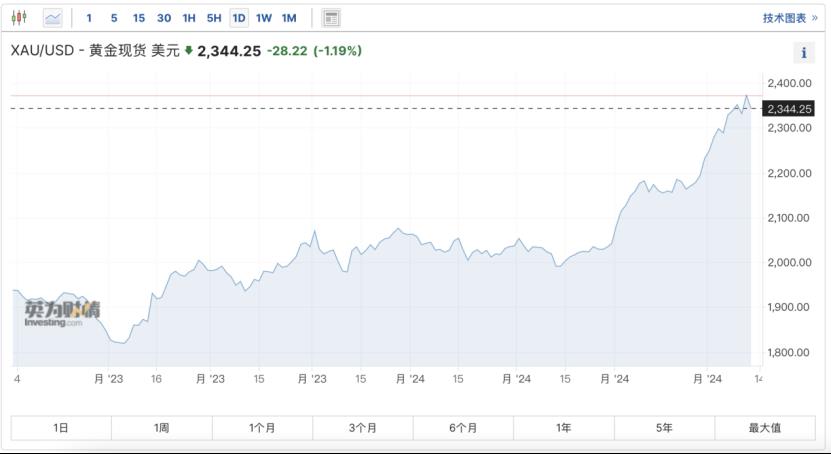
With the warming of risk aversion, the price of gold has hit record highs recently, which makes Wall Street "doubt life".

Among them, spot gold rose by 1.3% this week, that is, it rose by $30.5 per ounce. At one point this week, it rose to $2,431.53, and then it fell back. The latest price was $2,344.25, with a cumulative increase of 14% this year.

At the same time, the fluctuation of international oil prices is also intensifying. Brent crude oil, the global benchmark, once broke through 92 US dollars/barrel and jumped to the highest level since October last year. Since the beginning of this year, oil prices have soared by 19%.

The rising tension in the Middle East has disrupted the oil market. Ed Yardeni, the founder of Yardeni Research, a well-known wall street leader, pointed out that oil prices may reach $100 under the influence of this situation, and the situation in the Middle East has also weakened the upward momentum of US stocks.

The U.S. stock market also suffered a selling tide overnight. At the close, the Dow fell by 1.24% and fell below 38,000 points for the first time since January 24. The S&P 500 index fell by 1.46%, the biggest drop since Federal Reserve Chairman Powell’s speech on January 31 hit the expected interest rate cut in March. The Nasdaq fell 1.62%, the biggest drop since March 5.

As the tension between Israel and Iran worsens, Yardeni Research analysts say that if there is a real conflict between Israel and Iran, this may be the top of the US stock market.

It is worth mentioning that Wall Street’s so-called "panic indicator" VIX index rose to its highest level since October last year, and analysts warned that the market has always underestimated geopolitical risks.

Editor: Lin Gen

Proofreading: Yao Yuan