Rumor Spreading and Subject Responsibility of Social Media
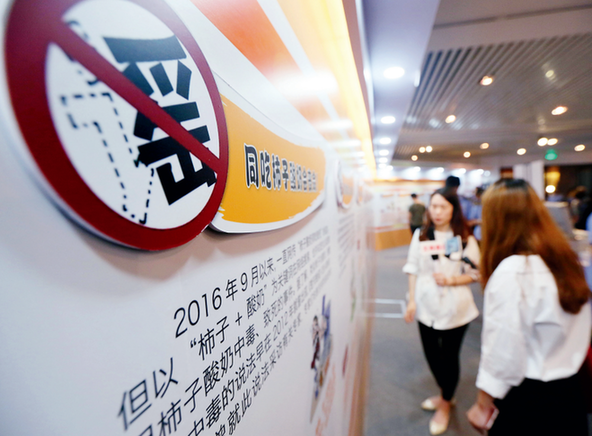
On June 6, 2017, at the launching ceremony of the establishment of the food safety demonstration zone in Dongcheng District, Beijing, the staff of Dongcheng District Food and Drug Administration conducted food testing activities of "food rumors" and "you point me to check", which attracted many citizens and media attention. Photo courtesy /CFP
According to a research report released by China Academy of Social Sciences in 2015, seven types of online rumors are the most, including food safety, disease and health, among which food safety rumors account for 45% of all online rumors, ranking first; Sina Weibo handled more than 1,200 false information in the first half of 2016, including 245 food-related rumors; Among the top ten rumors circulating in the circle of friends in the first half of 2017, four were about food safety, and so on.
At present, food safety rumors are flooding social media, some of which are unheard of, and some of which are repeatedly hyped and upgraded, showing the characteristics of fragmentation, sensationalism, storytelling and radioactivity. Therefore, when social media becomes the hardest hit area for the spread of food safety rumors, it intensifies the complexity of preventing and controlling the spread of online rumors.
New Characteristics of Rumor Spreading in Social Media Environment
As social media such as Weibo, WeChat, QQ Group and WeChat official account have broken through the thresholds of professionalism, technology and economic conditions, information dissemination has become more interactive, private, closed and highly relevant, and the spread of online rumors has also added new highlights and features.
First of all, the interpersonal communication environment of social media highlights the topicality of food safety rumors and easily causes widespread concern. Food is the most important thing for the people. The manipulation points of food safety rumors are food and safety. Food is the most basic physiological need of human beings, and safety is the most basic social need of human beings. Based on these two basic needs, it is easy to generate conversation materials and topics in the atmosphere of interpersonal communication. At the same time, the psychological fear caused by the exposure of some food safety problems in China in recent years is also easy to strengthen people’s attention to such problems.
Secondly, the relative privacy of social media circle of friends and the free mobility of cross-group communication enhance the public attribute and personalized and self-media communication color of food safety topics. For example, the circle of friends is private, but it does not belong to the real "private space". With the emergence of cross-circle and cross-group behaviors, rumors will continue to strengthen their "public" attributes and spread in the "public" space, generating unpredictable huge energy and chain reaction. In the meantime, platforms and individuals or groups that do not necessarily have the quality of professional communication have become important media between "circle" and "circle" and "group". Everyone is a microphone, a camera and a video camera. In this way, institutions or individuals in the form of opinions or even prejudices play a media role, and then become de facto editors, gatherers or information gatekeepers of social media information.
Third, the main communicators of social media usually establish relationships between people, people and groups, and people and the environment with "strong relationships" as the mainstay and "weak relationships" as the supplement. Based on common interests or opinions, the main communicators of social media are more homogeneous, and it is easier to form an opinion spiral and an information silkworm room effect, which promotes rumors to appear in a generally recognized false face and is more confusing.
Fourthly, the high coincidence rate between the online social circle and the real acquaintance circle and the vivid rich media form of food safety rumors have established a stronger emotional connection for the spread of rumors. Such rumors always appear in the form of reminding headlines such as "Please pay attention" and "Do you know" or sensational "headline party", and are often spread by means of pictures, texts, short videos, etc., and are accompanied by acquaintances’ opinions. It can be said that they are full of sounds and feelings, and they are often false and true, with a sense of reality. Most of the rumors do not forget to make a "warm reminder" at the end-asking for information to be forwarded to their concern and reality. The form is eye-catching, and the words are very warm-hearted, which makes it easier for people to have emotional closeness and concern, and strengthens people’s trust and emotional dependence. In the name of "love", many people unconsciously become helpers and pushers of online rumors.
Construction of Subject Responsibility in Social Media Communication
Although there are many reasons such as environment, platform, technology and skills, people are the most important measure in the development of science and technology and civilization after all. The most fundamental problem of rumor dissemination in social environment lies in the multi-subject and its responsibility.
The main body of responsibility in social media mainly includes four aspects: first, the enterprise as an operating platform; Second, opinion organizations, individuals and people who hold ideas; Third, all kinds of media with professional attributes; The fourth is the management department with supervisory responsibility. According to a survey conducted by the Social Investigation Center of China Youth Daily in 2015, the responsible subjects who should bear the consequences of online rumors in the minds of netizens are ranked in order of importance: first, "individuals or institutions that spread rumors" (accounting for 74.7%), second, "new media platforms that failed to fulfill their responsibilities" (accounting for 64.6%), third, "relevant regulatory authorities" (accounting for 56.0%), and finally. Although this ranking is mixed with the subjective will of a specific group of netizens to some extent, it also reminds us to pay full attention to the responsibility construction of social media and the importance of working together to build a credit network on the premise of fulfilling the main responsibilities of all parties.
To this end, it is necessary to enhance the social responsibility awareness of social platforms, new media enterprises and institutions, and improve the construction of media integrity system. Limitation, flow and number of users cannot be at the expense of truth, honesty and public interest, because freedom and responsibility have always been the two wings of civilization. Social media platforms should firmly establish a sense of corporate responsibility, and should not relax their responsibilities and behavioral norms for platform content managers themselves and communicators because of the consideration of freedom. We can’t deal with information rashly because of traffic and commercial interests. Internet companies weigh economic benefits and social benefits, as the General Secretary of the Supreme Leader said, "e-commerce platforms must actively guard against the sale of fake goods, and search rankings cannot be ranked high by whoever gives money, and social media cannot let rumors fly all over the sky." You can’t be the initiator or promoter of false information in order to cater to certain mentality, interest and market needs.
In the open Internet era, an effective responsibility system should be established to promote the presentation of real information and actively participate in rumors. For example, through the establishment of rumor channels and reporting platforms, we can standardize management responsibilities, attract and guide the public, and gather consensus and strength. New media platforms and institutions should take concrete actions to crack and terminate network rumors and build and maintain credit networks.
As an important force of social platform, professional news media should uphold professionalism, be a good watchman and gatekeeper of real information dissemination, and not give up or relax the pursuit of authenticity in order to grab speed and gain eyeballs; The media should also be the little secretary and good helper of users in good faith and pragmatically, truly proceed from people’s real wishes, pay attention to users’ needs, solve doubts and doubts, establish an authoritative rumor-dispelling mechanism, and enhance their rapid response ability. Once rumors are discovered, they should be corrected and corrected in time, leaving no opportunity for rumors. To this end, the media should establish three kinds of consciousness of seeking truth, looking forward and checking, play the role of executors, guardians and guides of honest culture, and enhance communication, credibility and influence.
To prevent and control the emergence and spread of social media rumors, it is more important to build the rational and critical ability of individuals and the public. For the vast number of network users, the main responsibility is the establishment of a sense of consciousness, but also an improvement of ability. Law-abiding is the bottom line requirement, and at the same time, we should improve our moral self-discipline awareness and network literacy. Enhance the understanding of media, laws of online media, communication methods and groups, and strengthen the study of modern scientific and cultural knowledge; Establish a rational understanding of social environment and social psychology; Enhance the ability to question, verify and resist bad information. To take health issues seriously, we should also break the pan-entertainment mentality, not be superstitious, not follow the trend, not blindly follow, not hype, strengthen the "immunity" against media rumors with laws and regulations, knowledge literacy, awareness of rights and responsibilities and self-discipline, and actively participate in rumors, helping and driving more people to form the behavior habit of rational use of the Internet and civilized communication.
From the perspective of managers’ responsibility, it is necessary to improve the release mechanism of authoritative information, improve the timeliness and accuracy of information disclosure, and solve the problems of information asymmetry and uncertainty. Improve the emergency mechanism to deal with information crisis, prompt authoritative departments to speak out at the first time, enhance transparency and help the public build confidence. We must also respond to the demands of netizens in a timely manner and communicate well. At the same time, pay attention to the combination of unblocking and blocking, strengthen the governance of cyberspace according to law, increase the cost of rumor anomie, and establish a more solid and powerful green barrier to prevent rumors and bad communication.
At present, China has promulgated many laws and regulations. The network regulations are mainly composed of laws formulated and passed by the National People’s Congress and its Standing Committee, administrative regulations stipulated by the State Council and administrative regulations formulated by the national network information office and other business departments. Civil Law, Criminal Law, Procedural Law and other laws have provisions on privacy and copyright protection to prevent and control the spread of online rumors; The Supreme People’s Court and the Supreme People’s Procuratorate jointly issued the Interpretation on Several Issues Concerning the Application of Laws in Handling Criminal Cases such as Defamation by Information Network, which clarified the behavior mode, incrimination standard and punishment of Defamation by Information Network. The "Ten Wechat Articles" and "Ten Interview Articles" issued by the National Network Information Office, etc., managing instant messaging tools such as WeChat with civilized and legal thinking is of great significance for preventing rumors and shaping the network integrity culture; The implementation of the Cyber Security Law since June 2017 has further strengthened the legal governance of online rumors and bad information dissemination.
In the social, mobile and digital environment where multiple subjects are intertwined, in order to achieve effective governance by punishing network rumors according to law, all parties must further interconnect and interact, jointly build a comprehensive, systematic, scientific and effective governance responsibility system, and create a clean and civilized cyberspace. (Meng Wei: Researcher, Institute of Journalism and Communication, China Academy of Social Sciences, Director of Network New Media Research Office)