Research Report on the Development of China Internet of Things Cloud Platform in 2021
China Internet of Things Cloud Platform Development Research Report in 2021 Original iResearch
Research Report on Internet of Things
Core summary:
The cloud platform of the Internet of Things is the central system linking the perception layer and the application layer. It takes the perception data as nutrients, and empowers the downstream applications through various IoT platforms, showing the logic of gradually upgrading the data value from upstream terminals to downstream users. It is a PaaS software with condensed functions and values. The Internet of Things cloud platform is now in the stage of full penetration, and public cloud deployment mode is preferred in most scenarios.
According to iResearch, the number of Internet of Things devices connected in China will reach 7.4 billion in 2020, and it is expected to exceed 15 billion in 2025. The continuous increase in the number of Internet of Things devices provides nutrients for the development of the Internet of Things cloud platform, and pushes the platform from the "quantitative change" of device and data accumulation to the "qualitative change" of data value mining.
The platform collects a large number of heterogeneous perceptual data, among which audio and video streaming data has the highest requirements for resources and equipment, and can be realized as soon as possible. In the smart life scenario, the market size of the Internet of Things cloud platform will be 5.8 billion in 2020, of which the market size of vision-related equipment will be 2.8 billion, with a compound growth rate of 26.9%. It is estimated that in 2025, vision-related devices will account for 62% of the total market size of smart life cloud platforms, and view-related cloud platform vendors will dominate the smart life field.
The market of Internet of Things cloud platform is highly dispersed, and various manufacturers have different development paths based on different advantages and purposes, and the trend of competition and cooperation is remarkable, seeking change while maintaining stability; In the future, the platform capacity will further sink to form the IoT base, that is, the "platform platform", and the third-party open platform will be fully integrated to provide professional technical support and services.

Concept and Status of Cloud Platform of Internet of Things
Concept of Internet of Things Cloud Platform
The central system linking perception layer and application layer, PaaS software with condensed function and value.
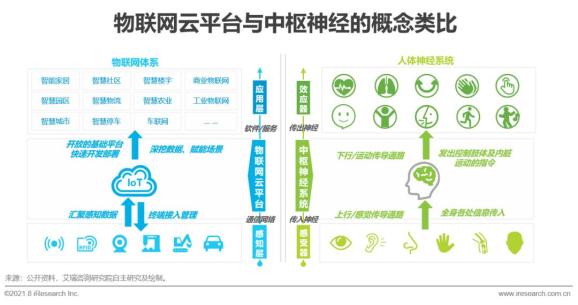
The Internet of Things cloud platform is formed by the gradual evolution of the concept of Internet of Things middleware. To put it simply, the cloud platform of the Internet of Things is the technical integration of the Internet of Things platform and cloud computing, and it is PaaS software erected on the IaaS layer. By linking the sensing layer and the application layer, it connects and manages the terminal devices of the Internet of Things downwards, collects and stores the sensing data, and provides the standard interface and common tool modules for application development upwards, and reaches the end users in the form of SaaS software (some industries are cloud platform software, such as industrial Internet of Things). Through data processing, analysis and visualization, The cloud platform of the Internet of Things is the central nervous system of the Internet of Things system. It is the value condensation of the Internet of Things industry to coordinate and integrate massive devices and information and build an efficient and continuously expanding ecology. With the increase of device connection, the precipitation of data resources, the improvement of analysis ability and the rich and in-depth application of scenarios, the market potential of the Internet of Things cloud platform will continue to be released.
Deployment Mode of Internet of Things Cloud Platform
Effectively solve the pain points of "Internet of Things" and "chimney", and prefer public cloud deployment.
The Internet of Things cloud platform is developed based on PaaS and follows the deployment mode of cloud services. It is usually divided into two modes: public cloud and non-public cloud (private cloud, hybrid cloud, private cloud, etc.). According to the calculation of iResearch, the overall cloud service market in China will reach 225.6 billion yuan in 2020, of which public cloud services will contribute 68%, which is the main deployment mode of the cloud service market at present. From the demand point of view, the characteristics of public cloud deployment, such as high openness, low-cost development and standardization mode and high reusability, are in line with the demand characteristics of the Internet of Things cloud platform, which can effectively solve the application problems such as lack of connectivity and scene fragmentation. From the application point of view, in the current life and production-related scenarios, most IoT cloud platforms are mainly deployed by public cloud, while in the government affairs, medical care, traffic security and other scenarios involving high demand for customized development and high network security privatization, IoT cloud platforms are more integrated into solutions as part of cloud capabilities and sold to end customers.

Internet of Things Cloud Platform System Architecture
Rooted in PaaS, it takes data as nutrients and provides the soil for data value incubation.
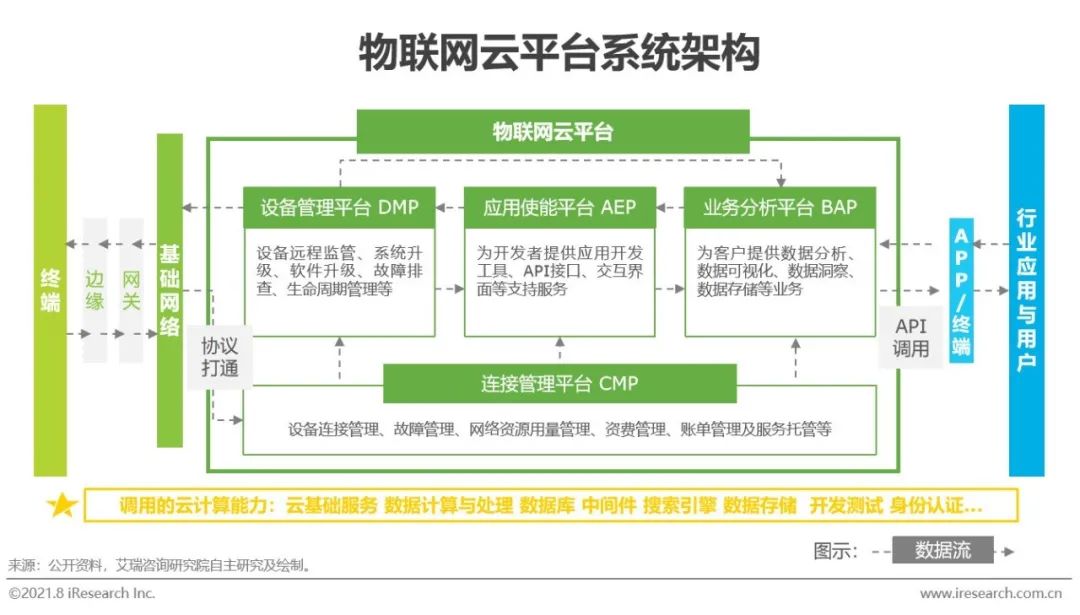
The cloud platform of the Internet of Things is located in the middle core layer of the Internet of Things technology, and its main function is to connect intelligent devices downwards and undertake the application layer upwards. The Internet of Things cloud platform is rooted in the PaaS environment, grows with data as the nutrient, and empowers the data to the downstream applications through various IoT platforms, showing the logic of gradually upgrading the data value from upstream terminals to downstream users. In the era of Internet of Everything, the promotion of data value is generated by the demand of unified management of cross-business IoT devices, and its key components are four types of IoT platforms: 1) Connection management platform: solving the problem of massive heterogeneous device access across business stacks; 2) Equipment management platform: unified management, control and firmware upgrade of equipment; 3) Application enabling platform: providing data development tools and environment; 4) Business analysis platform: leverage data analysis capabilities such as cloud computing and AI to provide customers with data insight services.
Development stage of Internet of Things cloud platform
In the stage of exploration and penetration of the whole industry, the core value is transferred to the upper scene service capability.
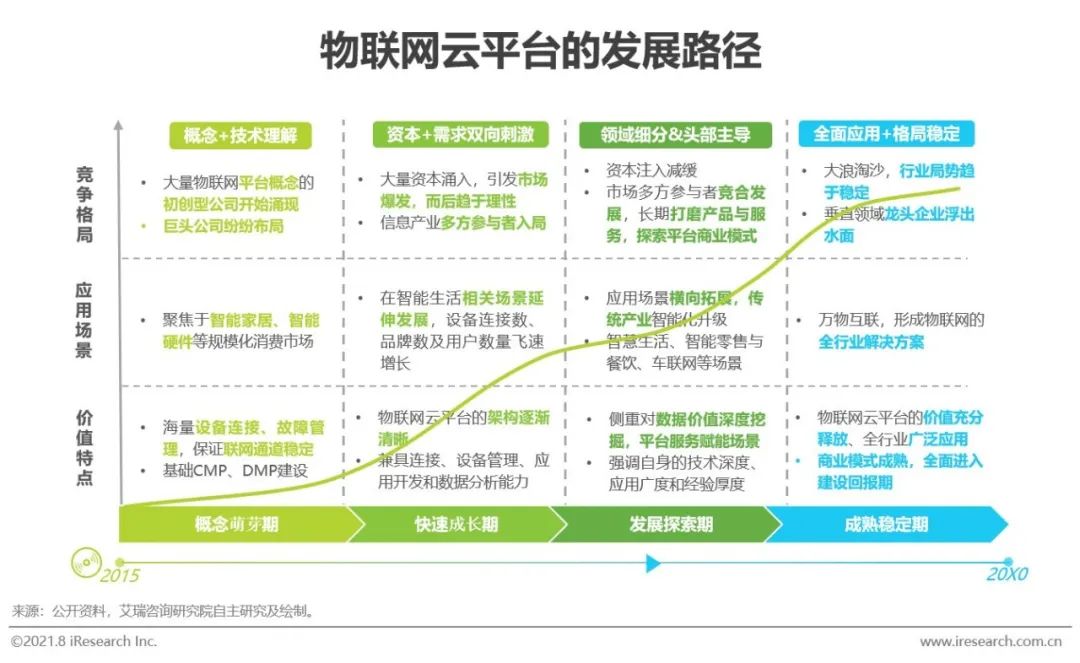
The cloud platform of the Internet of Things is in the inflection point stage after the precipitation mode exploration and before the rapid development. The development of the Internet of Things cloud platform benefits from the vertical ecological development of the smart home industry. After the number of connections, participants and users are increasing, the existing experience of cloud technology development and application is reused, and it continues to expand vertically to other application scenarios. With the rise of massive access and complex device type management, the core value of the Internet of Things cloud platform will also change from focusing on the underlying hardware to the multi-scenario business capability of the software platform with the development to a stable stage.
Market Environment of Internet of Things Cloud Platform: Policy
National and local policies support the upstream and downstream of industrial chain to build industrial ecology.
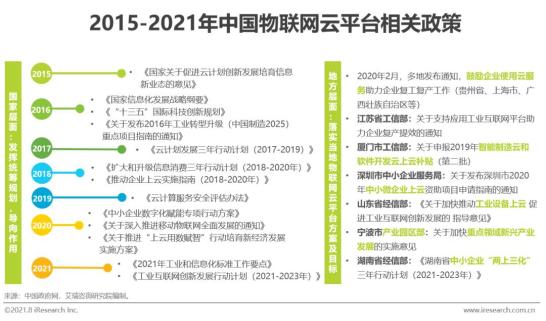
The CPC Central Committee and the State Council attached great importance to the function of cloud computing to promote efficient docking and collaborative innovation between upstream and downstream of the industrial chain, and effectively integrate various design, production and market resources, and issued policies and measures such as "the State Council’s Opinions on Promoting the Innovation and Development of Cloud Computing and Cultivating New Information Industry Format" (2015). From the supply-side perspective, the Ministry of Industry and Information Technology issued the Three-year Action Plan for Cloud Computing Development (2017-2019) and other documents, emphasizing the construction of enterprise-level SaaS platforms and supporting software companies to accelerate their transformation to cloud computing in order to establish an industrial ecosystem; From the demand side, the Ministry of Industry and Information Technology issued the Three-year Action Plan for Expanding and Upgrading Information Consumption (2018-2020) and other documents, organized enterprises to deploy "enterprises to the cloud" and promote the construction of new smart cities, and promoted the evolution of the real economy to digitalization, networking and intelligence.
Market Characteristics of Internet of Things Cloud Platform: Investment and Financing
After the peak period of investment, capital gathers in high-quality enterprises.
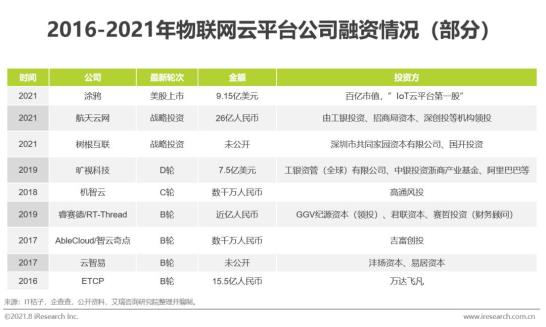
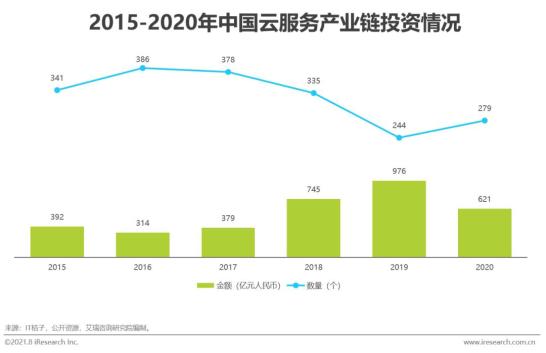
The heat of investment and financing events related to the Internet of Things cloud platform was concentrated in 2015-2018, and the scale reached its peak in 2019. Now it shows a gradual downward trend, and capital returns to rationality. In the category of Internet of Things cloud platform, due to the industry characteristics-the three major operators+Internet occupy most of the market share, and the initial investment of the platform is high and the profit is low. After the big waves, the capital mainly focuses on several head companies. In 2019, Greenland Holdings invested in graffiti intelligence, led it with Chengyun International in a two-line mode of "financial investment+industrial strategic cooperation", and established a joint venture company to promote cooperation in smart cities, smart communities and other fields. In 2021, the US stock market went public, positioning the first share of the global IoT cloud platform; Shugen Internet, which is deeply involved in the industrial Internet field, won four rounds of financing in 2021, including IDG, Jingwei, Tencent and other well-known domestic investment institutions.
The Pain Point and Breakage of Internet of Things Cloud Platform Market Development
Massive connections lay the foundation for the later market, and the ability of data analysis determines the upper space.


Value Analysis of Internet of Things Cloud Platform
Business Model of Internet of Things Cloud Platform
Multi-profit model with basic resource subscription, PaaS development and customized projects.
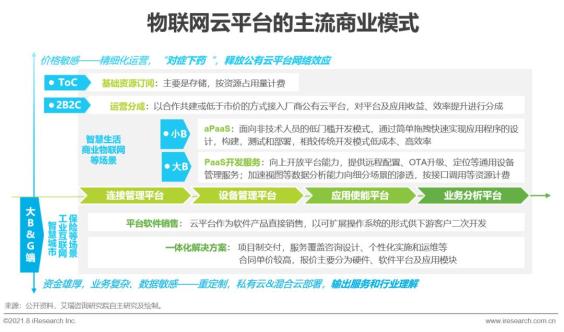
Internet of Things cloud platform is based on infrastructure positioning, adapting terminal access downwards, integrating industry applications upwards, directly serving developers with PaaS and reaching end users with SaaS. Specifically, in the scenes of home, retail and catering, the cloud platforms of the Internet of Things are mostly ToB, ToC and 2B2C modes, which are charged by means of resource subscription and operation sharing, among which resource subscription is divided into basic resource type, general type and business type according to resource types. However, government and large enterprise customers in smart cities, industrial Internet and other fields tend to provide customized services that integrate software and hardware, avoid data chimneys, and effectively solve the pain points of inefficient management and operation.
Connection of Internet of Things Devices in China
The number of device connections has increased steadily, which ushered in the key node from the number of connections to the qualitative change of data.
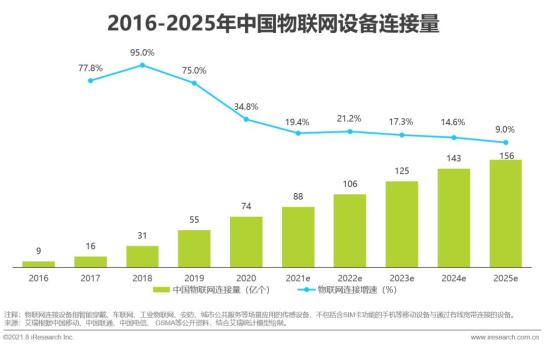
According to the calculation of iResearch, in 2020, the number of Internet of Things devices in China will reach 7.4 billion, and the growth rate will slow down year-on-year due to the epidemic. In the past, due to the huge scale of users, relatively simple requirements and high degree of standardization, the consumer Internet of Things occupied the mainstream of the connection volume. With the continuous advancement of digital transformation, the demand for Internet of Things in catering, retail and construction industries is increasing. It is estimated that by 2025, the number of Internet of Things devices connected in China will exceed 15 billion. The continuous increase in the number of Internet of Things devices provides nutrients for the development of the Internet of Things cloud platform, and pushes the platform from the "quantitative change" of continuous accumulation of devices and data to the "qualitative change" from application enablement to business analysis.
Data Types and Characteristics of Internet of Things Cloud Platform
It is the key to collect massive heterogeneous perceptual data and seize the high value of audio and video.
According to the data source, the data of the Internet of Things cloud platform can be divided into four categories, among which three types of data, namely, sensing data, device operation data, audio and video data and picture data, are directly collected by terminal sensing devices, while the fourth type of intermediate data is the reprocessing of the above three types of data to assist enterprise management decision-making. From the dimensions of data sampling period, cloud resources occupied, required equipment carrying capacity and delay tolerance, audio and video streaming data have the highest requirements for resources and equipment, followed by equipment running data high-frequency business data. In the Internet of Things architecture, the collection and access of massive data is the premise, and the concentration and processing of multi-source heterogeneous data is the focus. The Internet of Things cloud platform integrates multi-dimensional perceptual data, carries data traceability processing, statistical analysis and value mining, explores the internal laws of complex events, and then guides human life and production, which is the core link to realize the value of the Internet of Things.

Application Scenario of Internet of Things Cloud Platform: Life Field
The liquidity of view-related data is strong, and the market scale will approach 10 billion in 2025.
In 2020, the market size of China Smart Life Internet of Things Cloud Platform will be 5.8 billion yuan, and the compound annual growth rate is expected to be 20.4% in the next five years. In the smart life scenario, the main access data and the core realized data of the cloud platform are audio and video data and image data. Under the smart life scene in 2020. The market size of cloud platform for vision-related equipment is 2.8 billion yuan, with a compound annual growth rate of 26.9% in the next five years, which is mainly driven by the segmentation scenarios related to smart homes and smart community houses. In 2020 and 2025, vision-related devices accounted for 48% and 62% of the total market size of smart life cloud platforms, which once again verified the key position of view-related cloud platform vendors in the field of smart life.

Application Scenario of Internet of Things Cloud Platform: Life Field
Accelerated growth of connectivity+stock value mining, and continuous growth of vision driven by two factors.
In 2020, there will be 1.1 billion devices connected to the China Smart Life Internet of Things cloud platform, with a compound annual growth rate of 18.4%. Among them, the number of cloud platform connections of vision-related equipment is 230 million, with a compound annual growth rate of 32.1%. The extensive transplantation of vision modules and the innovative application of scenes have triggered a rapid growth in the shipment of vision-related equipment. At the same time, in the smart life scene in 2020, the comprehensive market contribution of stock equipment is 5 yuan/Taiwan, while the market contribution of vision-related stock equipment is 12 yuan/Taiwan. This difference comes from the multiple profit paths of the cloud platform of vision-related equipment, which not only benefits from the incremental market, but also pays more attention to the value mining of the huge stock market. From this perspective, the path exploration of realizing the cloud platform by view-related manufacturers has achieved a staged breakthrough and an industry demonstration role, and user stickiness training is the focus of future work.

Application Scenario of Internet of Things Cloud Platform: Production Field
In the primary stage of basic transformation and accelerated penetration, the market potential needs to be released.
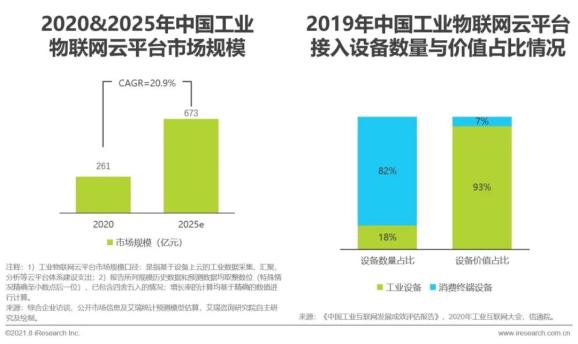
China’s industrial Internet of Things cloud platform is now in a critical stage of solid foundation and large-scale promotion and construction. According to the survey data disclosed in Industrial Internet Platform Application Data Map of Gongxin Security in July, 2021, the penetration rate of platform application in China is only 14.67%, and the overall cloud rate on industrial equipment is 13.1%. The difficulties such as insufficient market education and unclear business model need to be tackled, and the market potential needs to be released. It is estimated that the market scale of China industrial Internet of Things cloud platform will exceed 67 billion yuan in 2025, with a compound growth rate of 20.9%. In addition, the number of industrial equipment connected to the platform only accounts for 18% of the total, but the value accounts for 93%. The digital networking and protocol access of industrial equipment will be the top priority for a long time to come.
Application Scenario of Internet of Things Cloud Platform: Public Domain
The construction of urban wisdom center continues to advance, which is expected to drive the overall steady growth of the market.
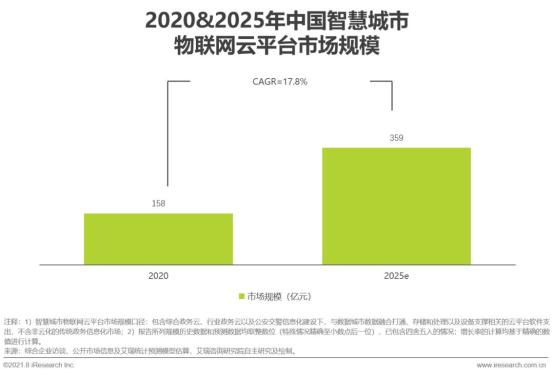
In 2020, the market size of China smart city IoT cloud platform will be 15.8 billion yuan, and it is estimated that the compound annual growth rate will be 17.8% in the next five years. The sustained boom of government demand will ensure the steady and rapid growth of smart city IoT cloud platform market. Specifically, the scale growth is mainly driven by the construction of software platforms related to the urban intelligent operation center (IOC)/ urban brain, which is a hot spot in the construction of new smart city platforms. Affected by the epidemic situation, the growth of the cloud platform market in the information construction of public security traffic police slowed down in the short term, and rose slightly in the medium and long term. It is estimated that the compound growth rate in the next five years will be 9%.

Analysis on Industry Competition of Internet of Things Cloud Platform
Internet of Things Cloud Platform Industry Competitive Elements: Data
Not only do you increase the number of connections, but the data value mining behind the scene is considerable
"Data" is the key nutrient of the Internet of Things cloud platform, and the competitive logic of the Internet of Things cloud platform also revolves around "data": 1) As far as the platform itself is concerned, manufacturers are more likely to gain the later data realization ability by increasing the number of connections. The massive connection and high concurrency require the platform to have at least basic data management and control, network connection and network security capabilities. 2) From the perspective of data production, manufacturers need to master more open data templates and data models to optimize algorithms, data and physical models; 3) From the perspective of economic benefits, the ability of data services determines whether vendors can realize cash quickly based on scenarios. On the one hand, vendors need to split services into different service components to supply different subdivided application scenarios, on the other hand, they also need to consider the product realization path of nonstandard solutions in order to achieve higher reusability.

Competitive Elements of Internet of Things Cloud Platform Industry: Products & Users
High degree of productization and low customer acquisition cost will result in economies of scale.
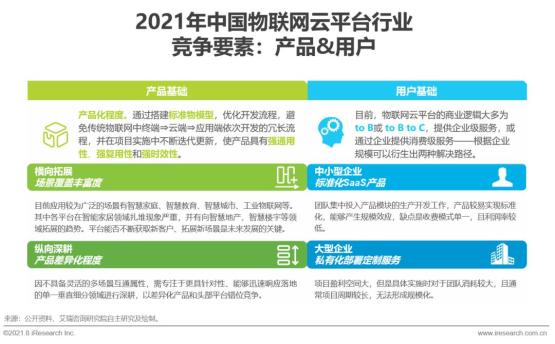
In essence, the Internet of Things cloud platform industry is that manufacturers, as the third party, adopt the business logic of 2B or 2B2C to provide platform services for B-end enterprises, developers and C-end consumers. Among them, large-scale enterprises and enterprises with no or weak development ability have customization needs, with high customer unit price but long project cycle, high single development cost and low overall profit rate. Cloud vendors combine and classify the various requirements of different customers, and develop a standard object model with strong versatility, reusability and timeliness. On the one hand, they can quickly iterate out products that meet specific fields for universal requirements, and misappropriate some functions on the basis of the original standard object model for special needs, and derive and develop customized products; On the other hand, in the face of customers whose needs are not clear, we can quickly provide suggestions according to the characteristics of the customer’s industry and reduce the customer’s understanding cost.
Competition Pattern of Internet of Things Cloud Platform Industry
Based on the differences of original attributes, manufacturers explore diversified development paths and seek change while maintaining stability.
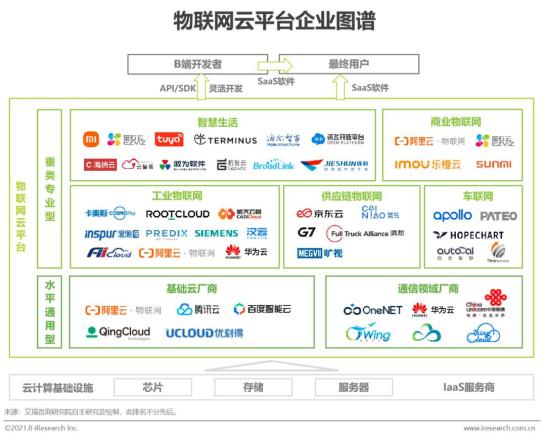
The Internet of Things cloud platform industry follows the typical characteristics of the Internet of Things market and is a highly decentralized long tail market. Vendors rely on their own core advantages to enter the market with different purposes and angles, which are mainly divided into the following five categories: basic cloud service vendors, communication vendors, software service and application system integrators, vertical traditional vendors and start-ups. Among them, basic cloud vendors and communication vendors mainly build general platforms and export the technical capabilities of full-stack open cloud platforms; Vertical traditional manufacturers and start-ups provide IoT cloud platforms in vertical scenarios based on their absolute advantages in segmentation or industry resources. China’s Internet of Things cloud platform market is developing steadily. It is expected that for a long time in the future, manufacturers will focus on their own business logic and strategic positioning, and continue to deepen their efforts to achieve the next turning point of growth.

Enterprise Atlas of Internet of Things Cloud Platform
Development Trend of Internet of Things Cloud Platform
Trend 1: deployment mode
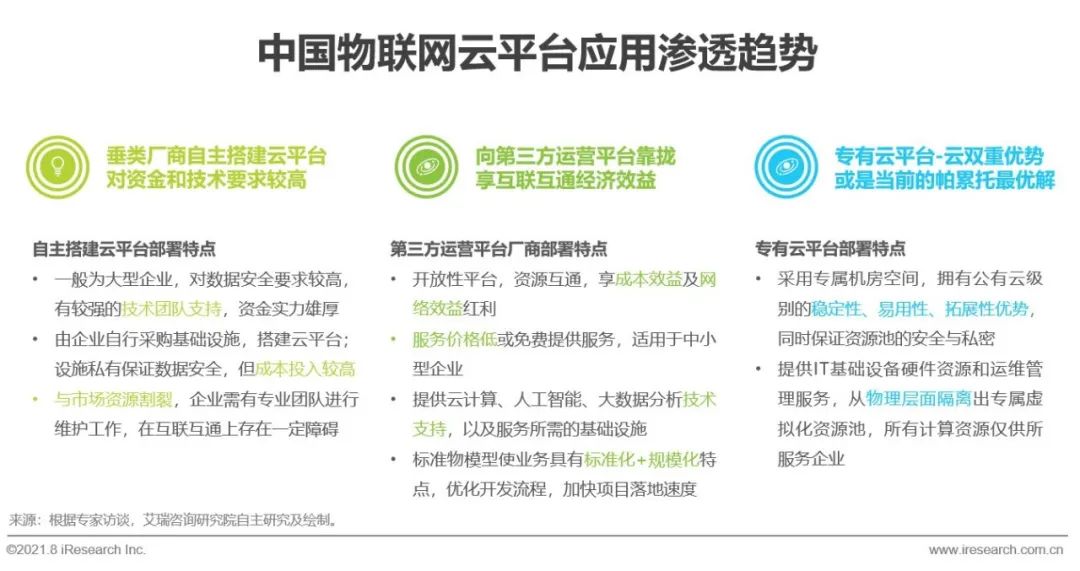
The public cloud deployment mode will dominate, and the proprietary cloud platform will meet the intermediate demand.
At present, enterprises in the fields of industry, urban transportation and security, which have high requirements for data security, mostly need to build their own cloud platforms, especially vertical hardware manufacturers have invested a lot of money in developing platforms to realize data self-control. The advantages of self-built mode are self-sufficiency and high data security coefficient, but it is also difficult to find a breakthrough in technology and user scale because it is not open to the outside world, resulting in the "uneconomical" effect of the application of Internet of Things cloud platform. According to iResearch, 1) With the gradual increase of equipment access to the network and the pursuit of economies of scale by manufacturers, more IoT platform enterprises set up in non-public cloud in the above scenarios will prefer the public cloud deployment mode to seek lower deployment cost and faster scale growth; 2) Small and medium-sized enterprises lack financial strength, or are more inclined to access third-party cloud platforms to enjoy the economic benefits of interconnection; 2) For enterprises with higher data security requirements and industrial enterprises or vertical hardware enterprises with moderate capital turnover ability, it is more suitable for the deployment mode of private cloud-the application layer is open and shared, and the resource pool is private and stable.
Trend 2: product evolution
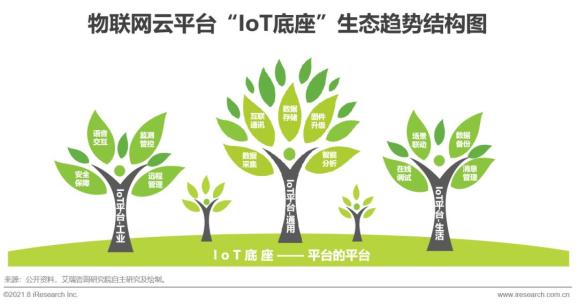
The platform capacity sinks to build an "IoT base", and the third-party operating platform takes advantage of the situation.
Basic cloud enterprises have the advantages of IaaS resources, and their PaaS capabilities have blossomed in many fields, and they also naturally have the ability to build a basic cloud platform for the Internet of Things. In the future, they will still extract common functional modules from the Internet of Things cloud platform to build platform products based on it. In addition, some IoT cloud platform enterprises that are pioneers in a certain field have even lower platform capabilities and can provide a complete set of products to support the development of other IoT platforms. According to iResearch, the above two types of enterprises tend to develop in the direction of "IoT base", spanning data collection, network transmission, security deployment, data analysis and other aspects, providing large-scale and standardized service support for multi-industry layout, and becoming the platform of IoT platform.
From the perspective of non-third-party cloud platform enterprises, small and medium-sized enterprises in a vertical field have the need to build their own Internet of Things cloud platforms, but they do not enjoy economic benefits. Start-ups do not have competitive advantages from the perspectives of zero development platform, cost, resources and time; According to iResearch, these two types of enterprises have the tendency to build their own platforms with the help of third-party open platforms, so as to obtain professional technical support, save development costs and improve production efficiency.
Trend 3: Nuggets Market
The value of view data is easier to mine, or becomes the key point of strategic layout of manufacturers.
The cloud platform of the Internet of Things can help manufacturers realize data value-added, that is, by reanalyzing the collected data, they can finally empower vertical intelligent terminal devices. For example, in the scene of life field, real-time capture of audio and video images-based data can find the correct "person", identify the specified behavior, and make accurate prediction, so as to meet the 2C/2B needs of smart homes, smart communities and other multi-scenes, and it is easy to realize value-added payment; In the industrial scene, "simulation training" is carried out on environmental data (mainly sensor data), and the "reasoning model" is obtained and fed back to the terminal equipment to optimize the operation process and improve the production efficiency; In the scene of vehicle networking, dynamic and static data (mainly sensor data) are collected from vehicle terminal equipment, and effective information is extracted from vehicle attribute information, path and functional requirements on the information network platform for supervision and comprehensive services. Judging from the closeness between the reprocessed data and the end consumers and the intelligent penetration rate of the scene, audio, video and picture data are the least difficult to realize, and it is the easiest to realize data realization.

Trend 4: Industry development pattern
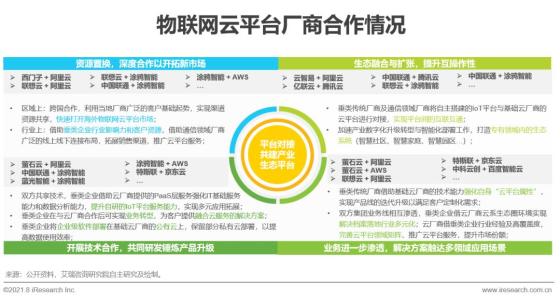
Cooperate in competition to jointly promote the development process of Internet of Things cloud platform industry.
In the process of development, the vendors of Internet of Things cloud platform can’t avoid the situation of competing for the connection market, and the market is relatively fragmented. At present, there is a trend among the five core vendors of the Internet of Things cloud platform to reach a cooperation agreement and give full play to their respective advantages, so as to realize the interconnection between the cloud platforms. For example, cloud platform vendors rely on the technological advantages of cloud computing, big data technology, artificial intelligence and other fields to provide PaaS services and software development platforms for enterprises, open up cloud account systems of both parties, and promote the intelligent deployment and digital transformation of traditional vertical enterprises; At the same time, it can also use the market coverage and service advantages of manufacturers in the communication field to widely aggregate content and applications, and use the advantages of vertical enterprises’ channel ability and coverage in traditional industries to open up new market areas and create multi-industry intelligent solutions.
Original title: Research Report on the Development of China Internet of Things Cloud Platform in 2021